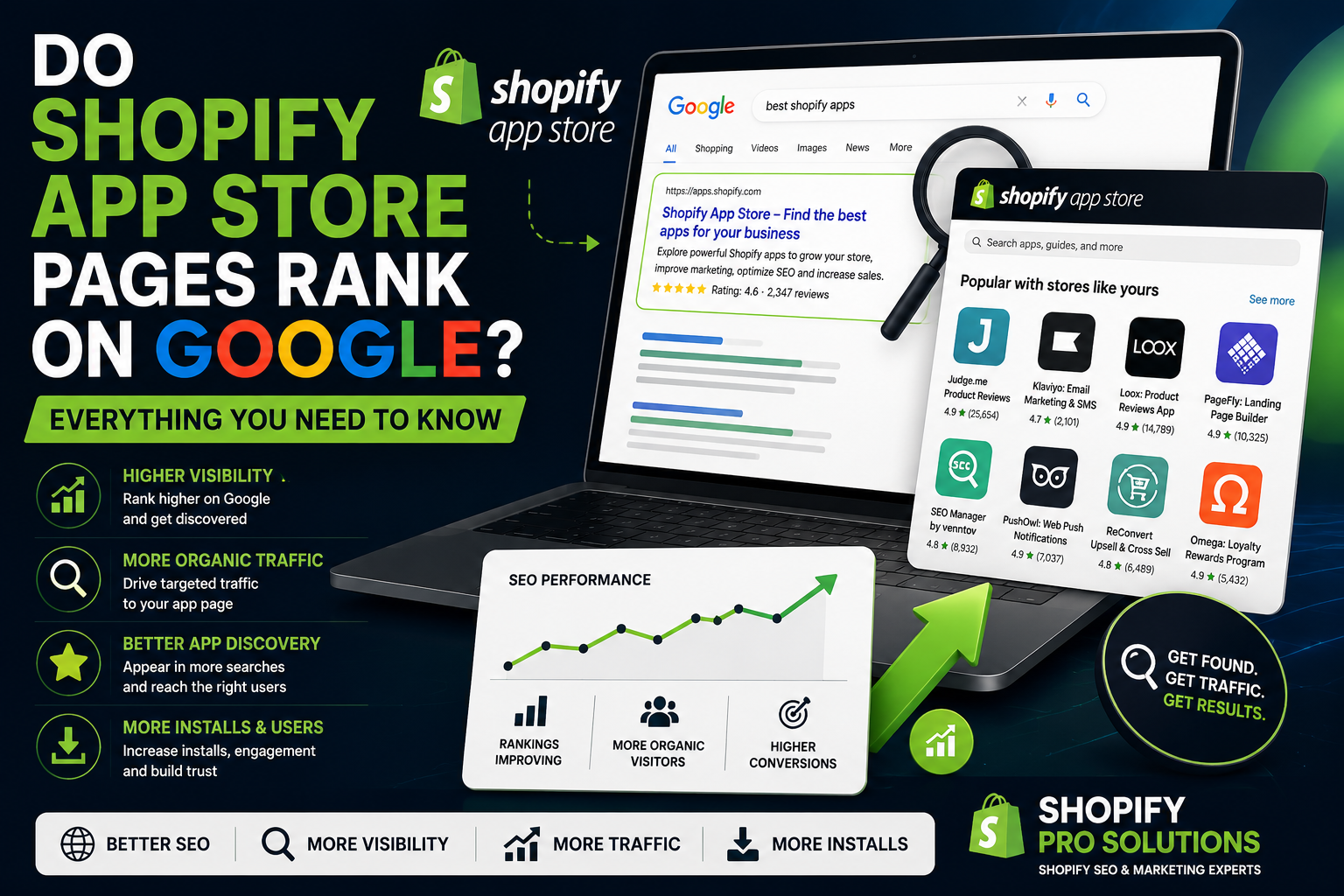
If you sell or build apps for ecommerce stores, you have probably asked a simple but important question: do Shopify App Store pages rank on Google? The short answer is yes, they can, but the reality is far more nuanced than a simple yes or no. Search visibility for an app listing depends on how the Shopify App Store is structured, how Google crawls and evaluates those pages, and how much authority your listing earns over time. In this guide, we break down exactly how app listings behave in search, what drives their rankings, and what you can do to compete.
Whether you are a Shopify merchant evaluating apps, an ecommerce founder scaling a store, or an app developer fighting for installs, understanding how these pages surface in Google is essential. Because organic search remains one of the most cost-effective acquisition channels, knowing the mechanics gives you a real advantage. So, let’s dig into the details and answer the question completely.
How Shopify App Store Pages Work
The Shopify App Store is a curated marketplace hosted on the apps.shopify.com subdomain. Each app has a dedicated listing page that includes a title, a tagline, a long-form description, screenshots, pricing details, and customer reviews. Shopify controls the structure of these pages, which means individual developers cannot fully customize the underlying HTML, meta tags, or schema the way they could on their own website.
Because Shopify owns the domain, every app listing inherits the considerable authority of the apps.shopify.com domain. This is a major advantage. A brand-new app does not start from zero in the eyes of Google, since it sits on a trusted, high-authority property. However, this shared structure also creates limitations. You compete against thousands of other listings on the same domain, and you have limited control over technical SEO factors. Understanding this trade-off is the first step toward setting realistic expectations.
Can Shopify App Store Listings Rank in Google Search?
Yes, Shopify App Store listings can and do rank in Google search results. Google indexes the apps.shopify.com subdomain, and many app pages appear for branded and category-based queries. For example, searching for a specific app by name almost always surfaces its App Store listing near the top. Likewise, broader queries such as “best Shopify upsell app” frequently return App Store category pages and individual listings.
That said, ranking potential varies dramatically by query type. Branded searches are easy wins because the listing matches the intent precisely. Competitive, high-volume category terms are much harder, because Shopify’s own category pages, review roundups, and affiliate blogs often dominate those results. Therefore, while the answer to whether these pages rank is a clear yes, the more useful question is how well they rank and for which keywords. The factors below determine that outcome.
What Factors Influence Rankings?
Several elements work together to influence where an app listing appears in Google. Some you can control directly, while others depend on signals you build over time. Let’s examine the most important ones.
App Title Optimization
Your app title is one of the strongest on-page signals you control. Google reads the title to understand what your app does, so it should be clear, descriptive, and aligned with how merchants actually search. Instead of a clever but vague brand name alone, include the core function. For instance, a title that combines your brand with a primary keyword, such as “Reviews and Ratings by [Brand],” communicates relevance to both users and search engines.
Descriptions
The app description gives you room to expand on features, benefits, and use cases. Although Shopify limits formatting, you can still write naturally and weave in the keywords merchants use. A well-structured description that answers common questions, lists key features, and explains outcomes performs better than a thin, generic one. Moreover, a detailed description helps Google understand the semantic context of your app, which strengthens relevance for related queries.
Reviews and Ratings
Reviews and ratings serve a dual purpose. First, they influence conversion by building trust with potential users. Second, they act as fresh, user-generated content that keeps the page active and topically rich. A listing with hundreds of positive, recent reviews signals quality and relevance. Consequently, apps with strong review profiles tend to rank higher within the App Store’s internal search, which often correlates with better Google visibility as well.
Backlinks
Backlinks remain one of Google’s most powerful ranking signals. When reputable blogs, review sites, and partner websites link to your App Store listing, they pass authority and signal trust. Because you cannot change the page’s internal structure much, off-page signals like backlinks become even more important for app listings. Earning links from ecommerce publications, case studies, and partner integrations can meaningfully lift your listing’s position.
Authority Signals
Beyond raw backlinks, broader authority signals matter. These include brand mentions across the web, engagement metrics, install volume, and the overall reputation of your app. Google increasingly rewards entities that demonstrate genuine expertise and trustworthiness. As a result, building a recognizable brand around your app, supported by content, community, and consistent quality, strengthens every page associated with it.
Common Reasons Shopify App Pages Don’t Rank
Many developers feel frustrated when their listing fails to appear for the terms they care about. Usually, a few recurring issues explain this. First, intense competition on the shared domain means thousands of apps target similar keywords, so only the strongest listings win. Second, thin or generic descriptions give Google little to work with. Third, a weak review profile signals lower quality and reduces both clicks and trust.
Additionally, some developers rely entirely on the App Store and build no external authority. Without backlinks or brand mentions, the listing has no off-page support to push it forward. Finally, search intent mismatches play a role. If your title and description do not align with what merchants actually type, Google will not surface your page, regardless of how good the app is. Addressing these gaps is often the fastest path to improvement.
SEO Best Practices for Shopify Apps
To give your app the best chance of ranking, follow a deliberate optimization strategy. Start with keyword research to understand exactly how merchants describe the problem your app solves. Then, place your primary keyword naturally in the title and weave related terms throughout the description. Because semantic relevance matters, cover the full topic rather than stuffing a single phrase.
Next, actively cultivate reviews. Encourage satisfied merchants to leave honest feedback, and respond professionally to every review, positive or negative. Beyond the listing itself, invest in off-page growth. Publish helpful content on your own domain, earn backlinks from ecommerce sites, and build partnerships that generate authoritative mentions. Together, these efforts compound over time and lift your visibility both inside and outside the App Store.
Can Shopify Store Pages and Blogs Rank Better Than App Listings?
This is where strategy becomes interesting. In many cases, your own Shopify store pages and blog posts can outrank App Store listings for valuable keywords, because you control every technical and editorial detail. On your own site, you can optimize meta tags, build internal links, add structured data, and create long-form content that fully answers a query. You simply cannot do all of that on a marketplace listing.
However, many merchants struggle with the opposite problem: their Shopify blog not ranking on Google despite consistent publishing. This usually happens because of thin content, missing keyword targeting, weak internal linking, or technical issues like duplicate tag pages and poor indexation. The good news is that a well-managed Shopify blog, supported by sound SEO fundamentals, can become a powerful asset that drives qualified traffic and outperforms a static app listing. If you want expert support, our Shopify store SEO agency helps stores fix these exact issues.
How Shopify Pro Solutions Helps Businesses Improve Shopify SEO
At Shopify Pro Solutions, we help merchants, founders, and app developers turn search visibility into measurable growth. Our team combines technical SEO, content strategy, and conversion-focused marketing to strengthen topical authority across your entire Shopify presence. Rather than chasing quick wins, we build durable foundations that keep performing as algorithms evolve.
We audit your store, optimize product and collection pages, and develop content that answers real customer questions. For app developers, we focus on the off-page authority and supporting content that App Store listings cannot provide on their own. Because every business is different, we tailor each engagement to your goals. To scale your acquisition further, explore how our Shopify store marketing agency services connect SEO with paid and lifecycle channels, or visit our homepage to see the full range of solutions we offer.
Conclusion
So, do Shopify App Store pages rank on Google? Absolutely, but their performance depends on competition, listing quality, reviews, and the external authority you build around them. App listings benefit from Shopify’s trusted domain, yet they also face structural limits that your own store pages and blog do not. The smartest approach combines an optimized App Store presence with a strong owned-media strategy on your website.
By optimizing titles and descriptions, earning genuine reviews, and investing in backlinks and helpful content, you give every page the best chance to rank. If you want a partner to accelerate that journey, Shopify Pro Solutions is ready to help you build lasting topical authority and generate qualified leads.
Frequently Asked Questions (FAQ)
Do Shopify pages rank on Google?
Yes. Shopify store pages, product pages, collection pages, and blog posts can all rank on Google when they are properly optimized. Because you control the technical and editorial details on your own store, these pages often have stronger ranking potential than marketplace listings.
Do Shopify App Store pages rank well in Google?
They can rank well, especially for branded searches, because they sit on the high-authority apps.shopify.com domain. For competitive category keywords, however, ranking well requires strong reviews, a detailed description, and external backlinks to support the listing.
Why is my Shopify blog not ranking?
A Shopify blog usually struggles to rank because of thin content, missing keyword targeting, weak internal linking, or technical indexation issues. Publishing longer, genuinely helpful articles and building a clear internal link structure typically resolves these problems over time.
Does Shopify have good SEO?
Shopify offers solid SEO foundations, including clean URLs, mobile-friendly themes, automatic sitemaps, and fast hosting. To compete in difficult niches, though, you still need a deliberate content and link-building strategy layered on top of those built-in features.
How long does Shopify SEO take?
Most stores begin to see meaningful movement within three to six months, while competitive keywords can take longer. SEO is a compounding investment, so consistent optimization and content creation produce the strongest results over time.
Can I control the SEO of my Shopify App Store listing?
You control the title, tagline, description, and screenshots, but not the underlying HTML, meta tags, or schema. Because of this, off-page signals such as backlinks and brand mentions become especially important for improving your listing’s rankings.
Do reviews affect Shopify app rankings?
Yes. Reviews build trust, improve conversion, and add fresh user-generated content to your listing. Apps with strong, recent review profiles tend to rank higher in App Store search, which often supports better Google visibility too.
Should app developers also invest in their own website SEO?
Definitely. Because App Store listings have structural limits, your own website gives you full control to publish optimized content, earn backlinks, and capture search traffic that a listing alone cannot. A combined strategy delivers the best long-term results.